As voices and footsteps of incoming audiences echoed within the First Congregational Church of Los Angeles on the night of Sept. 27, it was easier to imagine its looming arches and shadowy alcoves as the tetragonal structures of a sea cave. The nearly 18,000 organ pipes looked more like stalagmites, juxtaposed against a video projection on the ceiling of waves eroding rocks, an ocean’s surface wrinkling, a hermit crab flaunting its otherworldly textures.
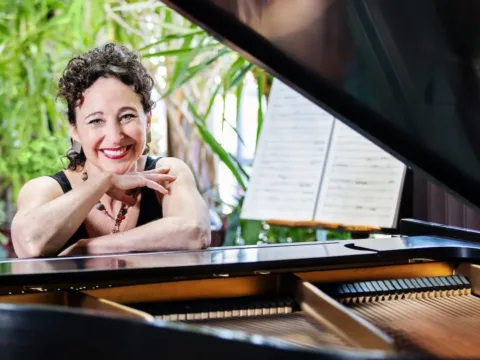
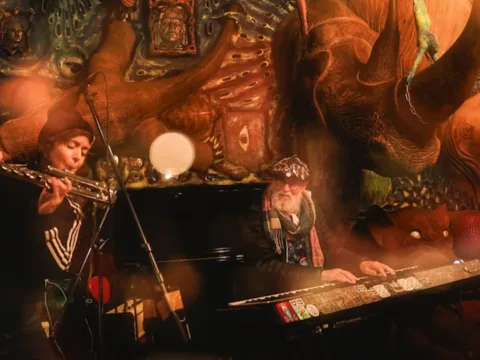
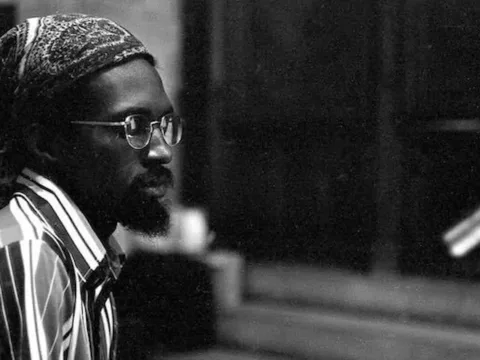
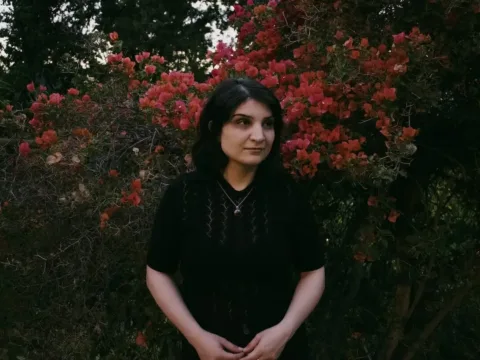
The mise-en-scène was apt for a performance demanding “geologic listening” — reaching, unfurling, and sensing the innumerable layers of sound beneath earth’s surface. Presented as part of The Resonance Collective’s Golden Thread Concert Series, “Lithic Breathing” implored listeners to resonate with the undulating breaths of nature, to listen with bodies rather than just ears. The program notes asked us, “What is it like to listen to a piano listen?” In an attempt for answers, the Santa Ana-based composer Julia Edith Rigby translated earth’s dialogue through her performances on viola, organ, and piano, and her collaborator, trumpeter Kafele Williams, improvised alongside her.
The Resonance Collective treats performance as ritual. The set-up was intimate by design: rather than sitting in the pews, audience members situated themselves at the front of the chapel, in close proximity to the instruments and performers. Preceding every concert, audiences participate in an “attunement,” guided by Artistic Director Fahad Siadat, by collectively humming and eventually harmonizing a given pitch. We were experiencing breath as a medium of collective resonance — before a performance where we would breathe with the earth.
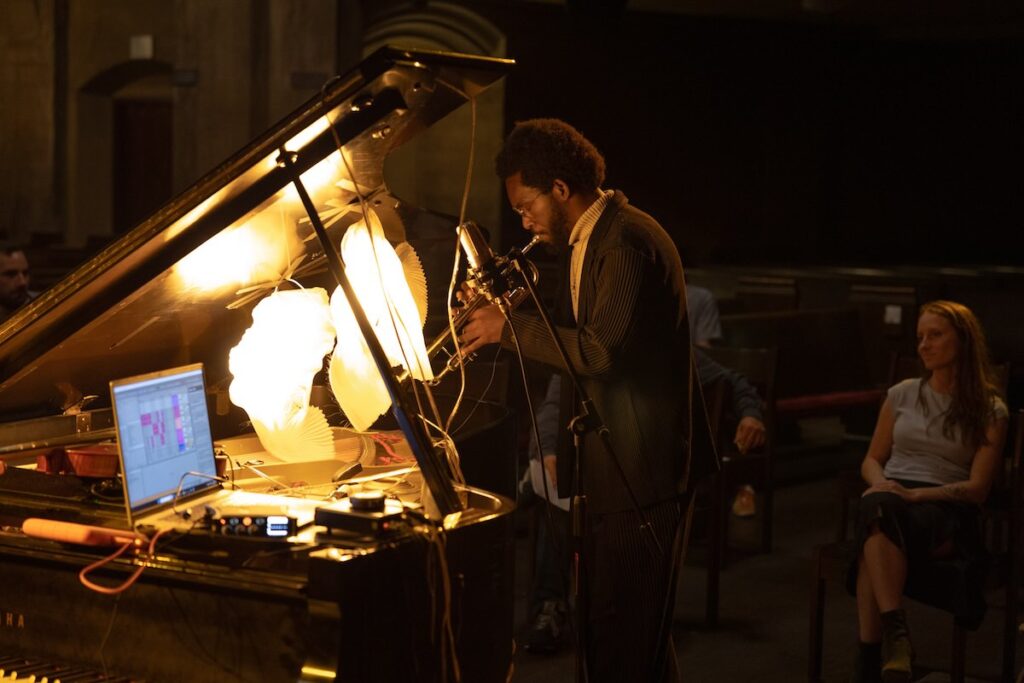
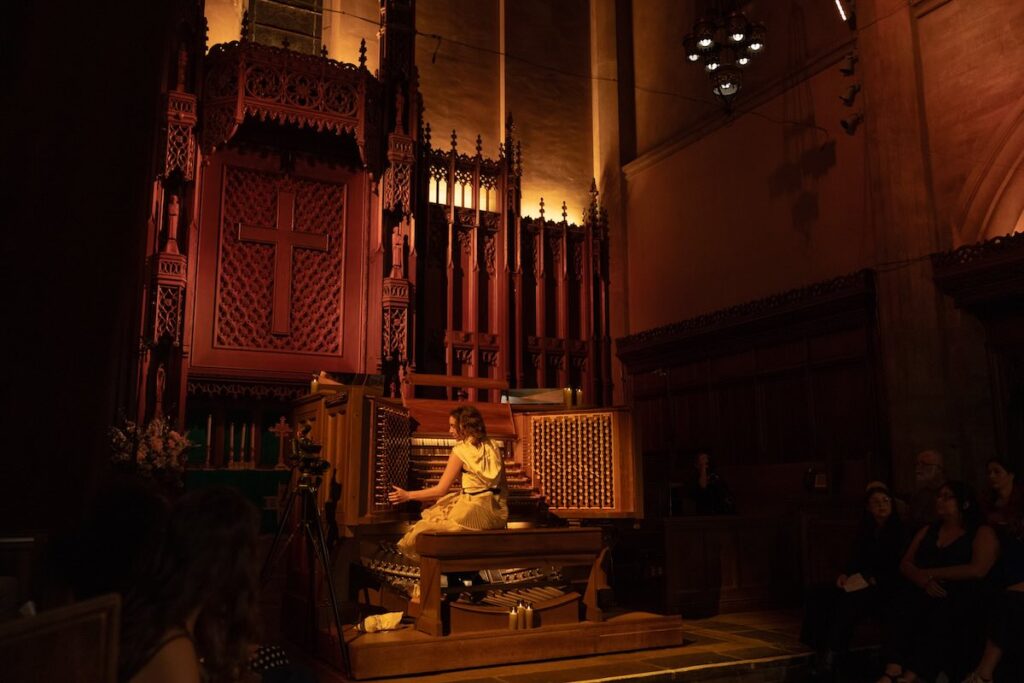
Clad in a silky chiffon dress with a texture mimicking rock folds, Rigby opened the hour-long work with a field recording of waves engulfing cave rocks — a sound familiar to human ears, but perhaps not yet understood as earth’s own corporeal language. Projecting the recording through her viola, she carried the instrument around the space, delivering the sound to us listeners. The duo accentuated the ambience: Rigby through a combination of percussive left-handed pizzicato, col legno, and physical tapping on the wood of the viola, with Kafele blowing unpitched air through his trumpet.
Rigby placed a weight on the lowest pedal on the organ, initiating an unflinching, continuous drone that would span the rest of the performance. The colossal vibrations of the world’s second largest pipe organ reverberated through the floor while she placed transducers onto the piano strings. The call of the earth’s rocks trembled violently through the softly lit piano, at times with such intensity that it sounded on the verge of breaking. Rigby dexterously adjusted the transducers to vibrate on various pitches, almost as if manipulating a stethoscope across the instrument’s body.
The piano felt nearly sentient: through tinny vibrations, it seemed to react to her field recordings with surprised yelps and agonized wails. So when Rigby began to play a simple, tonal melody on its keys, she was not simply improvising to the dialogue of lithospheres — she was comforting the instrument with an easy diatonality.
Eventually, the piano calmed and cleared away for the still ever-present field recording and low hum of the organ. Kafele, now in the back of the chapel, walked towards us down the aisle with a solemn, distant trumpet melody. Nearing the piano, he blared his trumpet into its strings; in response, the piano naturally echoed back with sympathetic vibrations, evoking the acoustics of a cave.
Rigby returned to the organ for a sonorous finale. For 20 powerful minutes, low fifths bloomed into guttural swells as she finessed the organ stops. Behind her, Kafele echoed her pitches on his trumpet, his brass sound barely audible through the organ’s cavernous crescendo. At this point, some audience members (me included) felt compelled to cover their ears when the vibrations reached thunderous peaks. The chapel boomed — or rather, drowned — in the secret music of rocks.
When Rigby softly lifted the final pedal on the organ, what remained of the work was the original field recording. As my ears adjusted, I didn’t hear rushing water in a sea cave. I heard encoded messages spoken by nature’s geologic breaths — messages that Rigby and Kafele offered me the chance to decode, and perhaps even to understand.
I CARE IF YOU LISTEN is an editorially-independent program of the American Composers Forum, and is made possible thanks to generous donor and institutional support. You can support the work of ICIYL with a tax-deductible gift to ACF. For more on ACF, visit composersforum.org.